
Encore Motorcars of Sarasota

Blog / Acura Repair

ACURA GEARBOX COMPLICATIONS: RESOLVE THEM IN SARASOTA WITH US

Acura-Grinding-Gears

Acura was the first luxury car brand designed and manufactured in Japan. The brand has, over the years, maintained its standing as one of the most reliable car brands in the world. In this article, we will look at one of the important components of an Acura: the gearbox.

The Gearbox System in an Acura

The gearbox is the part of your car that transmits the power from the vehicle engine to other parts of the car so that the car can move. The two types of gearboxes, namely the manual gearbox and the automatic gearbox system.

  • Manual gearbox system: This type of gearbox is used in cars built with an internal combustion engine. Gear is selected in the manual system with the use of a gear stick. Hence, the name manual gearbox system.
  • Automatic gearbox system: The automatic gearbox automatically changes the gear ratio as the car is in motion without the driver changing it manually.

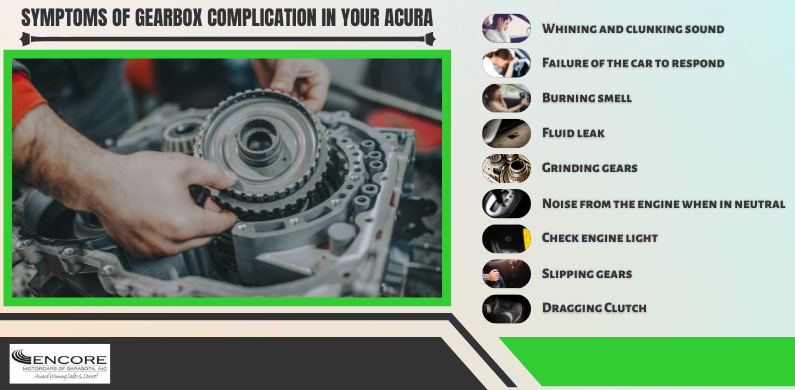
Symptoms of Gearbox Complication in your Acura

  • Whining and clunking sound: You may notice a low humming, whining, or buzzing sound when you change the gear. Sometimes, the sound may rise to a loud clunking sound.
  • Failure of the car to respond: If your car fails to respond after engaging the gears, it could be a sign of a gearbox problem. If you use an automatic gearbox, you would notice a delay when you put the gear in the drive or park. While in the manual system, the engine RPM would increase when the gear is shifted, but the car would not move as far as it should.
  • Burning smell: The parts of your gearbox are usually cooled and greased by transmission fluids so that they do not wear out or eventually become damaged. Sometimes this fluid may overheat, or you may be using bad fluid; this would cause the transmission system to overheat and mostly corrode. If this happens, you would notice a burning smell.
  • Fluid leak: Sometimes, problems in the gearbox of your Acura may be evident from leakage of the transmission fluid from the system.
  • Grinding gears: If you hear a noise or you notice a grinding feeling from the vehicle when the gear is shifted, this is a signal that the gearbox needs to be either adjusted or replaced. In the automatic transmission, you would notice a delay, or the transmission would start to shake.
  • Noise from the engine when in neutral: When you notice a jerk or a bumping sound when your vehicle is in neutral, this could be a result of problems in the gearbox.
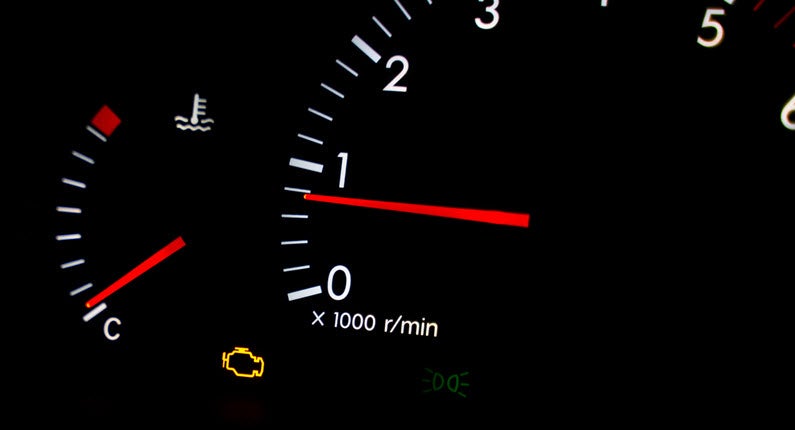
  • Check engine light: The check engine comes up when there is an underlying problem in your car, such as a transmission system problem.
  • Slipping gears: When the gear is shifted either automatically or manually, it should remain in that position. If you notice that it shifts from its position while you are driving, that is a very big issue that must be fixed as soon as possible because it can lead to serious damage.
  • Dragging Clutch: This issue occurs only in the manual system. If after you press the clutch pedal, the clutch disk refuses to disengage, this is a sign of a transmission problem because as long as the clutch is still spinning, the gear would not shift.
Causes of Gearbox Problems in Acura

Knowing the causes of problems in the gearbox would help you know and understand how to prevent your gearbox from failing.

  • Low or leaking transmission fluid: When the transmission fluid level drops, this could cause serious damage to the gearbox.
  • Worn-out gears: When any part of the gear wears out, it would cause a serious problem.
  • Clogged transmission filter: When the transmission filter is blocked, it would prevent the transmission from flowing through to the gearbox, and this would cause serious damage.

Encore Motorcars Will Resolve Your Acura Gearbox Complications
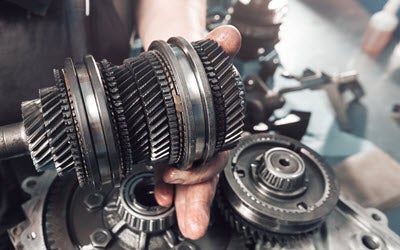
Encore Motorcars is the best repair shop to fix any issue with the gearbox of your Acura. We will run a diagnostic check of your car gearbox to determine the cause to know what solution we would provide. Our maintenance and repair service is provided to those who live or work in Longboat Key, Bradenton, Siesta Key, Parrish, Nokomis, Osprey, Ellenton, Venice, University Park, Lakewood Ranch, Sarasota, FL.

We have the most qualified, ASE-certified mechanics whose commitment is to provide your car with the best repair and maintenance service. Apart from Acura, we also provide service to JaguarBMWPorscheVolkswagenMercedesRolls-RoyceAudiMini, and Land Rover brands. Call us or visit our shop today to book an appointment!

Posted in:

Related Posts

Acura-Engine-Misfire

EXPERT ADVICE ON AN OXYGEN SENSOR FAILURE IN AN ACURA IN SARASOTA

An Acura model is characterized by its powerful engine, high-quality features, and stylish appearance. It periodically has problems with the oxygen sensor. The oxygen sensor is a small component, but when it fails, it will prevent your Acura from functioning properly. In order to avoid this problem in the future, it is good to know the main causes of oxygen sensor failure and how to deal with the problem if it crops up in your Acura. The Importance of the Oxygen Sensor The oxygen sensor is a component that’s used to detect the amount of oxygen in your Acura for the purpose of precise engine efficiency. The oxygen level detected by the sensor is sent to the vehicle’s computer so that it can determine whether or not there is enough oxygen in relation to fuel being utilized by your engine. If there is too little oxygen, this means that the air-fuel mixture in your vehicle is too rich. If there is too much oxygen, this means that the air-fuel mixture in your vehicle is too lean. Once the computer determines if you have a rich or lean fuel mixture, it will adjust the fuel injector output to compensate for it. This keeps your engine running until you can get it fixed. Unfortunately, an oxygen sensor failure can cause problems with how your engine runs and even cause it to be more difficult to start on cold mornings. It will also burn through your budget, as it can cause you to fill up at the pump far more than before. Signs of an Oxygen Sensor Failure The following are signs that indicate your Acura’s oxygen sensor is failing: Check engine light: A check engine light can indicate many different problems with a vehicle, but one of them is an oxygen sensor failure. In some cases, the light will remain on until a mechanic resets it manually. However, if you want to avoid this happening again and again, you need to replace your oxygen sensor as soon as possible so that you don’t have to pay another visit to your mechanic unnecessarily. Poor fuel economy: The first sign is poor fuel economy, which may not be noticeable until the vehicle has been driven for a few miles. If there is a problem with the oxygen sensor, it will take longer for the engine to reach its correct operating temperature, which means that it will use more fuel than usual. Engine misfire: An engine misfire can also be caused by a faulty oxygen sensor, and this is because the air-fuel mixture in the engine becomes unbalanced. In this case, the car may feel as though it is experiencing a loss of power. The vehicle may also hesitate when accelerating, and this will happen at various points in time throughout the driving experience.If you hear a knocking noise from your engine compartment, turn off your car immediately and call for help. Engine stalling: If you have ever been driving and noticed that your Acura tends to stall more than usual, it could be because of a faulty oxygen sensor. When the oxygen sensors malfunction, they send false information to the computer about how much oxygen is needed by the fuel injectors. As a result, too much or too little fuel may be injected into the engine and cause the vehicle to stall. The smell of sulfur: Your exhaust system can leak if there is a crack or hole in it somewhere, which will release a sulfur smell. This smell isn’t toxic to you, but excessive amounts of unburned gas can lead to carbon monoxide poisoning. If your exhaust system isn’t working properly, you could also be releasing harmful gases into the environment. What to Do When Your Oxygen Sensor Fails If you notice any of the above signs, bring your Acura to our professionals for inspection and diagnostics as soon as possible, as this can be a very expensive repair if not fixed sooner than later. At Encore Motorcars of Sarasota, we’re committed to making maintenance easier and more convenient, so drivers can enjoy their cars the way they were designed. We are Sarasota’s leading full-service auto center. We provide drivers with everything from sales to services for the most popular German, Exotic and Asian import auto brands in Venice, Longboat Key, University Park, Bradenton, Ellenton, Nokomis, Osprey, Parrish, Lakewood Ranch, Siesta Key, and Sarasota, FL. Give us a call at 941-922-6337 to book an appointment or stop by today. We are ready to provide you with a hassle-free experience that is guaranteed to have you satisfied no matter what your car needs.

Acrua-Illuminated-Check-Engine-Light

OUR EXPERTS IN SARASOTA WILL DIAGNOSE YOUR ACRUA’S CHECK ENGINE LIGHT ISSUES

The name Acura is derived from a Latin word “acu” which means accuracy. Reliability combined with this accuracy is what the brand is known for today. To provide accuracy of their engines, engineers designed the dashboard of each model to include a check engine light to alert you to potential problems with your car that will negatively affect the engine. The check engine light is controlled by the OnBoard Diagnostic ( OBD) system of the vehicle. Whenever there is an issue with the engine or other connecting components, the OBD detects it and the check engine light will turn on. The check engine light informs you of any issues with your engine immediately, thereby allowing you to pull over and have it towed or bring it to our repair shop. This safeguards the engine block and protects you, your passengers, and your vehicle. Potential Issue That May Cause The Check Engine Light To Come On The following are some common reasons why the check engine light of your Acura comes on. It is important to pay attention to your Acura, and never ignore the check engine light whenever it is illuminated. Malfunctioning Oxygen Sensor: If the oxygen sensor of your Acura is malfunctioning, it can cause the check engine light to come on. A malfunctioning oxygen sensor can improperly indicate that the catalytic converter of your Acura is under excess pressure. This case can be corrected by a professional mechanic that specializes in repairing Acura vehicles. Problem with Spark Plugs: Spark plugs help to ignite the fuel in the engine. If there is a problem with the spark plug, the car will misfire. This causes the check engine light to come on since it negatively impacts the engine. When this is the case, you need to replace or service the spark plugs. Faulty MAF Sensor: The Mass AirFlow (MAF) sensor supplies the correct amount of air required by the engine. If there is an issue with the MAF, the air/fuel mixture becomes lean and this would lead to misfires of the engine. The type of misfire that occurs is called lean misfire. When the MAF is faulty, the check engine light would be illuminated and you need to take your Acura for a check-up. Failed Catalytic Converter: This is the most serious cause of the check engine light being illuminated in your Acura. The catalytic converter system converts the toxic emissions produced by fuel combustion into environmentally-safe gases. If the catalytic converter of your Acura is faulty, your car would pose a danger to everyone around it and to the environment as well. Although it is very expensive to repair, it is important to have this repaired properly. Loose Gas Cap: A loose-fitting gas cap may cause the check engine light of your Acura to come on. When you forget to tightly close the gas cap of your vehicle, the fuel vapor may leak and the onboard diagnostic system might read this as an issue with the engine thereby turning on the check engine light. So if you see the engine light illuminate, check the gas cap first to see if it’s a quick and easy fix. Encore Motorcars Will Diagnose your Check Engine Light The check engine light can indicate different issues in your Acura. This is why it is important to diagnose the actual cause instead of spitballing the source of the problem, as there are many causes that can be detrimental to your engine. Ignoring the warning light is dangerous and it could lead to more expensive repair issues later down the road. At Encore Motorcars, we will perform a diagnostic test of the codes for your check engine light to determine the source and the best solution. We are committed to providing quality service to our customers in Bradenton, Ellenton, Nokomis, Osprey, Parrish, Venice, Lakewood Ranch, Longboat Key, Siesta Key, University Park, Sarasota, FL. We have highly qualified, ASE-certified mechanics who are committed to the care of your vehicle. Our mechanics are also experts in fixing the most popular German brands such as Mercedes, BMW, Mini, Porsche, Audi, Volkswagen, Rolls-Royce, Jaguar, and Land Rover. Call us today to book an appointment!

Acura-Car

HOW TO HANDLE A LOUD RATTLE IN AN ACURA IN SARASOTA

Rattling noises in or on your car can be unnerving to say the least and can be caused by a wide number of issues. Perhaps you only hear the rattling when you first start your vehicle, or only what you’ve stopped. The rattle may only occur when accelerating, decelerating, hitting bumps, turning or it might be constant. Whatever the cause is, you undoubtedly want to correct the issue right away. While some rattles may be due to minor, easily fixed issues, others might be symptomatic of much more serious problems that only a mechanic should tackle. Read on to try to get to the bottom of the rattles on your vehicle. Where is the rattling noise coming from? The first thing you’ll want to do is to narrow down the exact location of the rattling. There are four main areas, and if you can figure out which area the sounds are coming from, you can be that much more informed. The four main areas of your vehicle are as follows: underneath your vehicle inside the wheel wells under the hood inside your vehicle Loose Exhaust System The exhaust system on your vehicle runs from your engine all the way to the rear of your vehicle. It is composed over several different components including the catalytic converter, sections of the tailpipe, and the muffler. As time passes, the parts can become worn down and the joints that hold them into place can loosen causing rattling noises from underneath your vehicle. You might notice that the rattling seems to be coming from under the vehicle rather than the tailpipes themselves. Furthermore, if your exhaust system is loose, it may bang against the underside of your vehicle causing a momentary rattle. Bad Catalytic Converter When speaking of exhaust systems, the catalytic converter could also be responsible for the rattling you hear. The job of the catalytic converter is to convert toxic gas and pollution into less dangerous substances. This device can either be damaged by thermal shock or impact, both of which can lead to broken and rattling parts. A faulty catalytic converter could either be a slight rattle noise or extremely loud. Aside from any obvious rattling, another sign of a bad catalytic converter could be a warning light in your dashboard. Loose Heat Shielding Due to increasing emissions regulations, engines and exhaust systems must operate at higher temperatures than before. This increase in temperature means that heat shielding has had to be added to exhaust components like catalytic converters, mufflers, and exhaust pipes. This shielding is designed to reflect extreme heat away from the bottom of your vehicle. Made of thin pieces of metal, heat shielding is located between your exhaust system and the underfloor of your vehicle. Over time, this shielding can rust out or become loose and rattled against other parts. Inside the Wheel Wells Your vehicle’s suspension system contains many different components which include the springs, struts, sway bars, and links. Your steering system is also an important part of your suspension system. Over time wear and tear can cause any of the parts to become rusted and/or loose which could lead to shaking and rattling. Other parts that end up causing rattling noises include your brakes, your wheels, and your tires. Under the Hood If the oil level in your vehicle gets too low, your oil pump may end up sucking in air and sending through the engine with any remaining oil. This can cause either a ticking or rattling noise from your engine. Another source of rattling from under the engine could be due to low-octane fuel. Low octane fuel can cause carbon deposits, a bad knock sensor, overheating, or incorrect ignition timing. Another result of low-octane fuel could be rattling. Inside the Vehicle Rattling noises that are coming from inside your vehicle may be less serious than exterior rattling but just as annoying. If you only hear the rattling when you hit a bump or go around a tight curve, it’s likely that the rattling is coming from an area that opens and closes, such as your glove compartment, doors, or interior storage areas like the console. Where to Take Your Vehicle in Sarasota * Acura Car image credit goes to: Vicky Gosselin. If you can’t locate or fix the rattling on your own and you live in the Bradenton, Ellenton, Nokomis, Osprey, Parrish, Venice, Lakewood Ranch, Longboat Key, Siesta Key, University Park, or Sarasota, FL areas, stop by Encore Motorcars so our experts can take a look at your Acura to resolve the rattling noise.